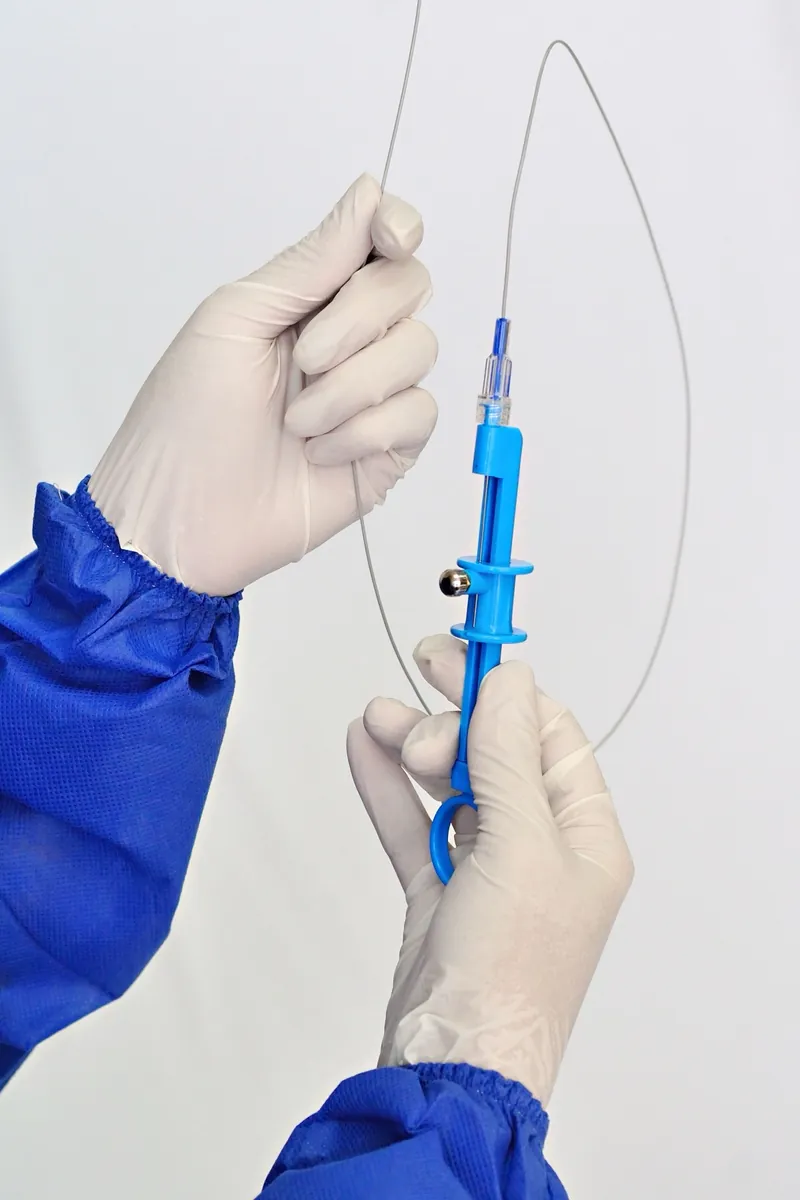
A May Thurner syndrome stent is a small, flexible metal mesh tube placed inside the left iliac vein to hold it open where an artery presses on it. Iliac vein stenting is also used when a vein in the pelvis has been scarred and narrowed by an old clot. This guide explains when a stent is offered, what happens on the day, life on blood thinners afterwards, how well stents work and what can go wrong. For the condition itself, see our guide to May-Thurner syndrome.
May-Thurner treatment options
Not everyone with a squeezed iliac vein needs a procedure. Treatment depends on symptoms and whether there is a clot:
- No symptoms. No treatment is usually needed, even if a scan shows compression.
- Mild symptoms. Compression stockings, raising the leg, regular walking and avoiding long periods of sitting may be enough.
- A new clot (DVT). Blood-thinning medicine is the main treatment. For a large, recent clot, a specialist may remove or dissolve it with a catheter, then stent the narrowing so the clot is less likely to return.
- Ongoing symptoms from the narrowing. A stent is the main option.
A balloon alone does not work well here. The artery keeps pressing on the vein, and scar tissue inside the vein springs back. Open surgery is now rarely used.
Who needs an iliac vein stent?
A stent is considered for symptoms, not scan findings alone. About one in four people without leg problems have the vein narrowed by more than half on CT, and most never need treatment. Specialists usually consider a stent when:
- The narrowing causes troublesome symptoms, such as left leg swelling, heaviness, bursting pain when walking, skin changes or a venous ulcer. These are explained in May-Thurner syndrome symptoms.
- There has been a clot in the iliac or thigh veins linked to the narrowing.
- An old clot has left the vein scarred or blocked (post-thrombotic iliac vein obstruction), causing long-term swelling and pain.
- Blood is diverted into the pelvis, contributing to pelvic congestion, in selected women. See pelvic venous disorders for how compression and pelvic veins connect.
The decision weighs how much the symptoms affect your life against the need for blood thinners, follow-up scans and a permanent implant.
The iliac vein stent procedure
The procedure is usually done by a vascular surgeon or interventional radiologist in an X-ray theatre. Details vary between hospitals, but the usual steps are:
- Anaesthesia. Local anaesthetic with sedation, or a general anaesthetic. Stretching the vein can be uncomfortable, so pain relief is given.
- Access. A needle is placed into a vein, usually in the thigh, behind the knee or in the neck. No large cut is needed.
- Venogram. Contrast dye is injected so the veins show up on X-ray. Our guide to the pelvic venogram explains this test.
- Intravascular ultrasound (IVUS). A thin ultrasound probe is passed inside the vein. It measures the narrowing and the vein’s true size more accurately than X-ray, which helps choose the right stent and where to place it.
- Balloon and stent. A balloon stretches the narrowed section, then the stent is released. Most are self-expanding stents designed for veins.
- Final check. Further images confirm blood is flowing freely. The puncture is closed with pressure, glue or a stitch.
It usually takes one to two hours. You may go home the same day or stay one night.
Blood thinners after a stent
A new stent is at most risk of clotting in the first weeks, before the vein lining grows over it. You will usually be given an anticoagulant, an anti-platelet medicine, or both. How long depends on why you needed the stent:
- After stenting for compression alone, often a few months
- After a clot, or with a clotting tendency, often longer, sometimes long term
Blood thinners raise the risk of bleeding and bruising. Tell any doctor or dentist that you take one. Never stop or change the dose without your specialist’s advice. If you are planning a pregnancy, discuss it with your team early, because some blood thinners are not used in pregnancy.
How well do stents work?
Results are best when the vein was squeezed but never clotted. A 2015 review of 37 studies and almost 2,900 patients found that at one year the stent was still open without further treatment in about:
- 96% of people stented for compression without a clot
- 87% after a recent clot
- 79% after an old clot had scarred the vein
With a repeat procedure when needed, the figures rose to 89 to 99%. A 2026 randomised trial in 225 people with severe post-clot symptoms (C-TRACT) found that stenting improved leg symptoms and quality of life at six months compared with standard care, but bleeding was more common in the stent group.
Many people notice less swelling and heaviness. But not everyone improves, symptoms from long-standing skin damage may only partly recover, and most studies are not randomised. Long-term follow-up is still limited.
Risks of iliac vein stenting
Serious problems are uncommon, but possible risks include:
- Bruising or bleeding at the puncture site
- A clot in the stent, which is more likely after stenting for an old clot
- Re-narrowing of the stent over time
- Stent movement, which is rare
- Allergic reaction to the contrast dye or effects on the kidneys
- A clot travelling to the lungs, which is rare
Some people need a further procedure, such as balloon stretching inside the stent, to keep it working.
Recovery after an iliac vein stent
- Walking is encouraged on the day of the procedure to keep blood moving.
- Back or groin ache is common for one to two weeks as the vein stretches. Simple painkillers usually help.
- Bruising at the puncture site settles over a week or two.
- Activity. Most people return to desk work within a few days. Ask your team when to restart heavy lifting, sport and long-haul travel.
- Compression stockings may be advised for a few weeks.
Our page on living with May-Thurner syndrome covers longer-term life with a stent. A Singapore vascular surgeon’s article on iliac vein compression also describes stenting and the recovery period.
Follow-up and iliac vein stent failure symptoms
You will have duplex ultrasound scans to check the stent, usually within the first weeks and then at intervals, often yearly. These aim to spot narrowing before symptoms return.
Contact your team promptly if swelling, heaviness or aching in the leg comes back after improving. Keep any stent card you are given and mention the stent before any scan, operation or MRI.
When to see a doctor
See a doctor if you have ongoing left leg swelling, heaviness or pain on walking, or if symptoms return after a stent. You can use our pelvic symptom check to organise your thoughts before an appointment.
Get help the same day for sudden swelling and pain in the leg, which can mean a clot in the stent, or for bleeding that will not stop. Call for emergency help if you have sudden breathlessness, chest pain, coughing up blood or fainting. In Singapore, call 995 in an emergency.
Frequently asked questions
What is the treatment for May-Thurner syndrome?
It depends on whether you have symptoms or a clot. No symptoms usually means no treatment. Mild symptoms may be managed with compression stockings and staying active. A new clot is treated with blood thinners, sometimes with a procedure to remove it. Ongoing symptoms from the narrowing, or a clot, are the main reasons to consider a stent.
Is an iliac vein stent permanent?
Yes. The stent is designed to stay in the vein for life. The vein lining grows over it within weeks. It cannot usually be removed, which is one reason the decision to place one should be made carefully.
What are the symptoms of iliac vein stent failure?
Leg swelling, heaviness or aching that comes back after improving can mean the stent is narrowing. Sudden swelling and pain in the leg can mean a clot in the stent and needs same-day medical care. Follow-up scans aim to pick up narrowing before symptoms return.
Can I have an MRI scan with an iliac vein stent?
Most modern venous stents are labelled MR conditional, meaning scans can be done safely under certain settings. Always tell the scanning team you have a stent and show any stent card you were given, so they can check the exact device.
How long do I need blood thinners after a stent?
It varies. Most people take a blood thinner or anti-platelet medicine for at least several months while the stent heals in. People who have had a clot, or who have a clotting tendency, may need it for longer. Your specialist will set the plan; never stop on your own.
Is there iliac vein compression treatment without a stent?
For people without symptoms, no treatment is needed. For mild symptoms, compression stockings, leg raising and regular walking may help. Balloon stretching alone tends not to last, because the artery keeps pressing on the vein. Open surgery is now rarely used.
Sources and further reading
- Society for Vascular Surgery — A guide for patients: May Thurner syndrome (PDF)
- Cambridge University Hospitals NHS — Deep venous intervention (stenting): patient information
- Razavi MK et al. Safety and effectiveness of stent placement for iliofemoral venous outflow obstruction: systematic review and meta-analysis. Circ Cardiovasc Interv 2015
- Vedantham S et al. Endovascular therapy for post-thrombotic syndrome: a randomized trial (C-TRACT). N Engl J Med 2026
- Mangla A, Hamad H. May-Thurner Syndrome. StatPearls (NCBI Bookshelf)
- Kibbe MR et al. Iliac vein compression in an asymptomatic patient population. J Vasc Surg 2004
This article is general information, not personal medical advice. Please speak to a doctor about your own symptoms. How we create our content.