People searching for nutcracker SMA syndrome are usually trying to untangle two rare conditions with confusingly similar names. Both involve the same blood vessel, the superior mesenteric artery (SMA). In nutcracker syndrome, the SMA squeezes the vein from the left kidney. In SMA syndrome, it squeezes part of the small bowel. The cause is shared, but the symptoms, tests and treatments are quite different, and some people have both.
One artery, two “pinch points”
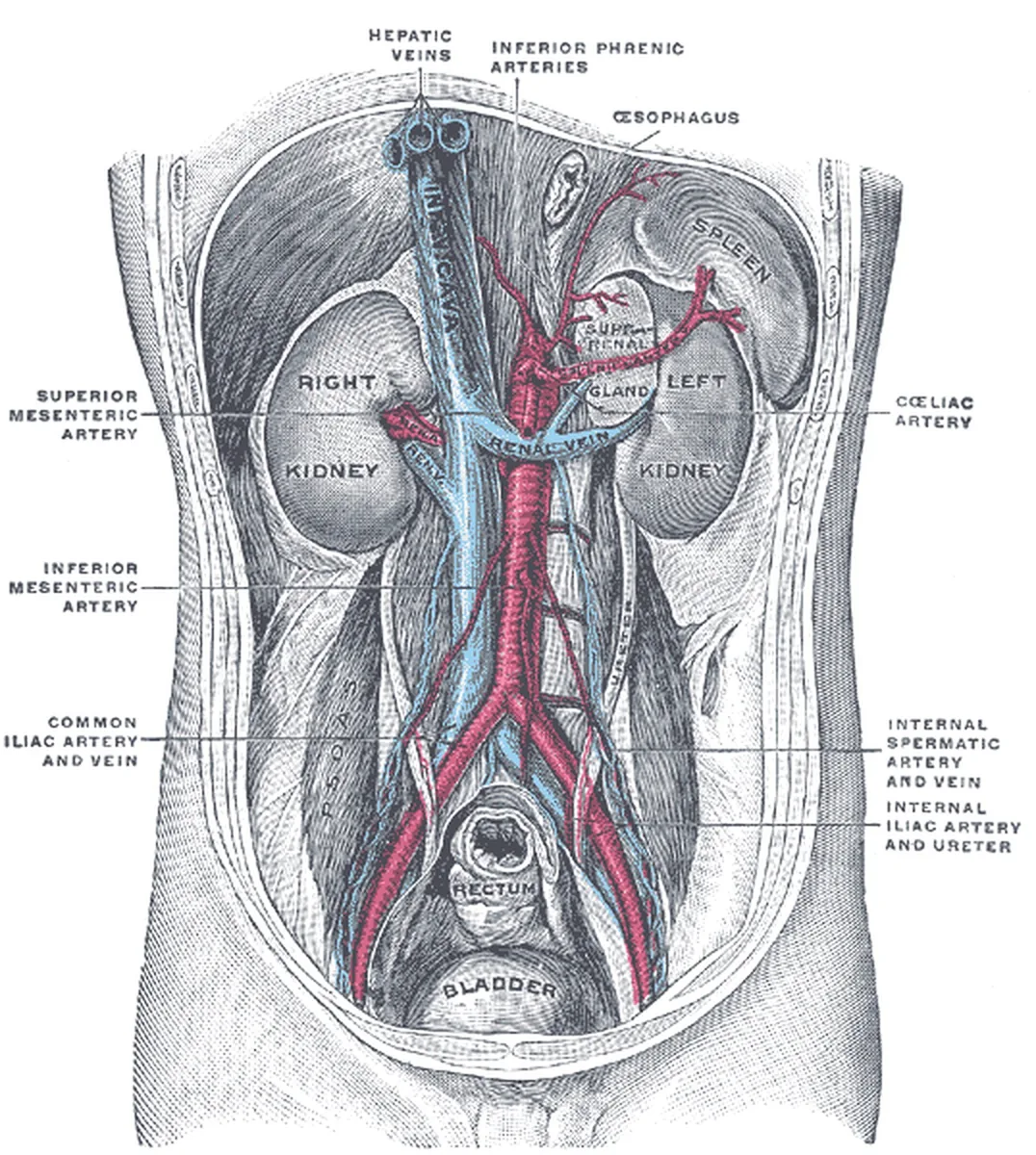
The aorta, the body’s main artery, runs down the back of the abdomen in front of the spine. Just below the diaphragm, the superior mesenteric artery branches forward from it to supply the gut. The two arteries form a narrow V shape.
Two important structures pass through the gap inside that V:
- The left renal vein, carrying blood from the left kidney across to the main vein (the inferior vena cava). The left ovarian or testicular vein drains into it.
- The third part of the duodenum, the first section of small bowel after the stomach, as it crosses from right to left.
Normally, fat and lymph tissue cushion the SMA and hold the V open. If the angle is unusually narrow, or that cushion shrinks, the artery can press down on whatever lies beneath it. Our guide to how the pelvic and kidney veins are laid out shows where the left renal vein fits in.
Nutcracker syndrome in brief
When the left renal vein is squeezed, pressure builds up behind the narrowing. Blood looks for other ways out, often down the left ovarian vein into the pelvis, or the left testicular vein in men. This can cause:
- Blood in the urine, which may be visible or found only on testing
- Pain in the left side or flank
- Pelvic vein congestion in women, with a dull, heavy pelvic ache
- A left-sided varicocele in men
Read the full guide to nutcracker syndrome and its symptoms in more detail.
SMA syndrome in brief
When the duodenum is squeezed, food and fluid cannot pass easily from the stomach into the rest of the bowel. It behaves like a partial blockage. SMA syndrome is also known as Wilkie syndrome or aortomesenteric duodenal compression. Typical symptoms are:
- Pain or cramping in the upper tummy after eating
- Feeling full very quickly, bloating and nausea
- Vomiting, sometimes of partly digested food or bile
- Weight loss, because eating becomes uncomfortable
A vicious cycle can develop: weight loss shrinks the fat pad, which narrows the angle further, which makes eating harder still. Symptoms are often eased by lying on the left side or on the front, or in a knee-to-chest position, and made worse by lying flat on the back.
Nutcracker syndrome vs SMA syndrome: side by side
| Nutcracker syndrome | SMA syndrome | |
|---|---|---|
| What is squeezed | Left renal (kidney) vein | Third part of the duodenum (small bowel) |
| Body system | Veins and kidney | Digestive system |
| Main symptoms | Blood in urine, left flank pain, pelvic heaviness, varicocele | Pain after meals, early fullness, nausea, vomiting, weight loss |
| Key tests | Doppler ultrasound, CT or MR scan, venography with pressure measurements | CT scan with contrast, barium or contrast X-ray study, endoscopy |
| First approach | Often watchful waiting, healthy weight gain | Nutrition and fluids, healthy weight gain, positioning |
| Procedures if needed | Vein repositioning surgery, bypass, or sometimes a stent | Bowel bypass surgery (often keyhole) to route food around the squeeze |
Who gets them?
Both conditions are more often reported in slim teenagers and young adults, especially women, and after rapid growth or significant weight loss. SMA syndrome can also follow major surgery that straightens the spine, long periods of bed rest, burns, or illnesses that cause severe weight loss.
Both are considered rare, and both can be overdiagnosed. A narrow angle between the arteries is fairly common in thin people who feel perfectly well. A scan finding on its own is not a diagnosis; it has to fit the symptoms.
Can nutcracker and SMA syndrome happen together?
Yes. Because the kidney vein and the duodenum share the same gap, a very narrow angle can squeeze both. A number of case reports describe people with both conditions at once. When this happens, symptoms from each can mix together: for example, pain after meals and weight loss alongside blood in the urine and left-sided pain.
If you have been diagnosed with one, it is reasonable to ask your doctor whether your symptoms could suggest the other. But having one does not mean you have, or will develop, the other.
How are they tested?
The tests overlap because the same area is being looked at:
- CT or MR scan with contrast. Shows the arteries, the kidney vein and the bowel together. Radiologists can measure the angle and distance between the SMA and the aorta.
- Doppler ultrasound. Checks blood speed and flow in the left renal vein. See our guide to pelvic venous ultrasound.
- Venography. An X-ray of the veins with contrast dye, sometimes with pressure measurements, used to confirm nutcracker before treatment.
- Contrast X-ray of the bowel and endoscopy. Show whether the duodenum is widened above the squeeze and rule out other causes such as ulcers.
- Urine and blood tests. Look for blood in the urine, kidney problems, anaemia and the effects of vomiting or poor nutrition.
Other conditions that can look similar include kidney stones, kidney or bladder disease, stomach ulcers, gallbladder problems, eating disorders and other causes of bowel blockage. These need to be considered first.
Treatment directions
Treatment depends on which structure is squeezed, how severe the symptoms are and your age.
Shared first steps. For both, regaining a healthy weight under supervision can rebuild the fat cushion and ease the squeeze. A dietitian is often involved. Many younger people improve without any procedure.
For nutcracker syndrome, options range from watchful waiting to surgery that moves the kidney vein to a less crowded spot, bypass operations, or, in selected adults, a stent. If pelvic veins are badly congested, they may be treated too. See nutcracker syndrome treatment for the pros and cons of each.
For SMA syndrome, the first step is usually to rest the stomach and restore fluids and nutrition. This may mean small, frequent liquid meals, or a feeding tube placed beyond the squeeze, or nutrition through a drip in hospital. If this does not work, a surgeon can join the duodenum to a lower loop of bowel so food bypasses the pinch point. This is often done by keyhole surgery.
When both are present, treating the weight loss and the bowel problem often comes first, because it can help both conditions. Care is usually shared between a gastroenterologist or general surgeon and a vascular surgeon or interventional radiologist. For background on how pelvic vein congestion from nutcracker is managed, a Singapore vascular surgeon’s pelvic congestion syndrome page gives another overview.
When to see a doctor
See a doctor if you have blood in your urine, ongoing left-sided pain, pelvic heaviness that builds through the day, or pain after meals with unplanned weight loss. Our pelvic symptom check can help you organise your symptoms before an appointment.
Get urgent medical help for repeated vomiting so you cannot keep fluids down, vomiting blood or green fluid, severe tummy pain, heavy blood or clots in the urine, very little urine, fainting, or signs of dehydration such as confusion or a racing heart. In Singapore, call 995 in an emergency.
Frequently asked questions
What is the difference between SMA syndrome and nutcracker syndrome?
Both are caused by the same artery squeezing something. In SMA syndrome the squeezed structure is the duodenum, so the symptoms are digestive: pain after eating, vomiting and weight loss. In nutcracker syndrome it is the left kidney vein, so the symptoms are blood in the urine, left side pain and congested pelvic veins.
Can you have nutcracker and SMA syndrome at the same time?
Yes. Both the left kidney vein and the duodenum pass through the gap under the SMA, so a narrow gap can squeeze both. Doctors have reported a number of such cases. It is still uncommon, and having one does not mean you have the other.
Why does weight loss matter in both conditions?
A pad of fat around the SMA helps hold it away from the aorta. When someone loses a lot of weight, this pad shrinks, the angle narrows and squeezing becomes more likely. This is why both conditions are often seen in slim young people, and why regaining weight is part of treatment for both.
Which tests show nutcracker SMA syndrome?
A CT or MRI scan with contrast can show the SMA, the aorta, the kidney vein and the duodenum together, and measure the angle between the arteries. Doppler ultrasound checks blood flow in the kidney vein. A barium or contrast swallow and an endoscopy are often used to look at the duodenum.
Is SMA syndrome dangerous?
It can become serious if it stops you eating and drinking enough. Repeated vomiting can cause dehydration, salt imbalance and malnutrition, which need hospital care. With the right treatment, most people improve.
Sources and further reading
- StatPearls — Superior Mesenteric Artery Syndrome (NCBI Bookshelf)
- StatPearls — Nutcracker Syndrome and Left Renal Vein Entrapment (NCBI Bookshelf)
- Kurklinsky AK, Rooke TW. Nutcracker phenomenon and nutcracker syndrome. Mayo Clin Proc 2010
- Navandhar PS et al. Understanding superior mesenteric artery syndrome. Cureus 2024
- Shi Y et al. Superior mesenteric artery syndrome coexists with nutcracker syndrome in a female: a case report. BMC Gastroenterol 2019
This article is general information, not personal medical advice. Please speak to a doctor about your own symptoms. How we create our content.