Varicocele embolization (spelled embolisation in the UK and Singapore) is a way of repairing a varicocele without surgery. Instead of tying off the faulty veins through a cut, a specialist blocks them from the inside through a needle hole, guided by X-ray. Most men go home the same day. This guide explains how the procedure works, who it suits, how its results compare with surgery, and what recovery and risks look like.
For the bigger picture, including when any treatment is worth considering, see our guide to varicocele treatment.
What is varicocele embolisation?
A varicocele is a cluster of widened veins above the testicle. It forms when valves in the testicular vein fail, so blood falls back down and pools around the testicle instead of draining towards the heart. Read more in our varicocele overview.
Embolisation stops that backflow. The specialist, usually an interventional radiologist, closes the faulty testicular vein from the inside. Blood from the testicle then drains through other, healthy veins, and the swollen veins in the scrotum gradually shrink.
It is the same technique used in women to treat pelvic vein reflux. See ovarian vein embolisation.
Who is it suitable for?
Embolisation is an option for most men who need a varicocele repaired, for the usual reasons: ongoing pain, fertility problems with an abnormal semen test, or a teenager whose testicle is not growing properly. It may particularly suit men who:
- Have a left-sided varicocele, the most common type, which is usually straightforward to reach
- Have a varicocele that has come back after surgery, because embolisation can find and close veins the operation missed
- Prefer to avoid a general anaesthetic or a surgical cut
- Need to get back to work or sport quickly
It may be less suitable if you have a serious allergy to X-ray contrast dye, kidney problems that make contrast risky, or veins whose shape makes them hard to reach. Your specialist will look at your scan and discuss this with you.
What happens during the procedure?
Before the procedure, you may be asked not to eat for a few hours, and to stop blood-thinning medicines for a short time if your doctor advises it. Tell the team about any allergies, especially to contrast dye.
On the day:
- Numbing. You lie on an X-ray table. The skin over a vein in the groin, neck or arm is numbed with local anaesthetic. Many centres also offer light sedation through a drip to help you relax.
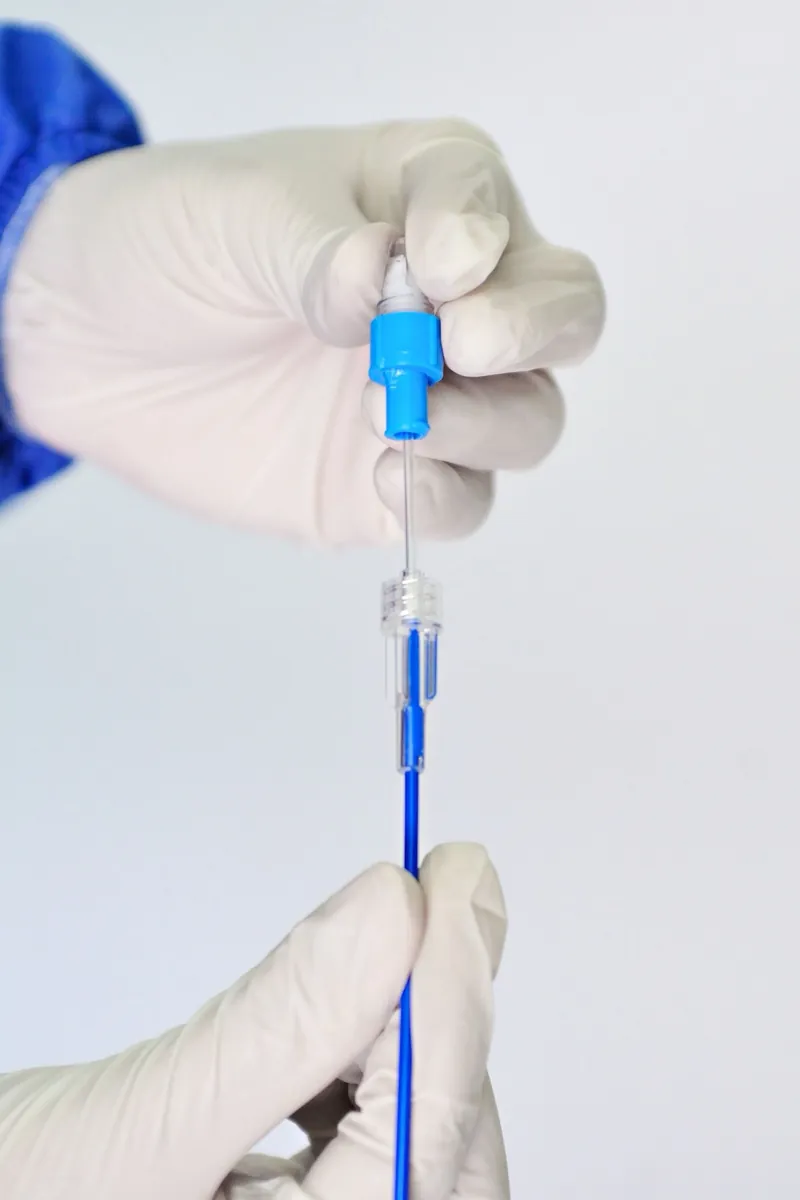
- Access. A thin plastic tube (catheter) is passed into the vein through a tiny nick in the skin, a few millimetres long.
- Mapping. Using X-ray, the specialist guides the tube to the testicular vein and injects contrast dye. This shows where the blood is flowing backwards and whether there are extra side branches.
- Blocking the vein. The vein is closed from the inside with tiny metal coils, a sealing foam or liquid (sclerosant), medical glue, or a combination. The choice depends on the anatomy and the team’s experience. We compare these in coils, glue and foam for embolisation.
- Finishing. The tube is removed and pressure is applied, then a small dressing is put on. There are no stitches.
The procedure usually takes about an hour or less. Most men feel little more than pressure. Some notice a brief warm sensation or an ache in the side or back when the vein is closed.
Varicocele embolization success rate
Patient information from interventional radiology societies quotes success in about 90 in 100 procedures. Success here means the faulty vein is reached and closed. In a small number of men, under about 5 in 100, the vein cannot be reached because of its shape or spasm. Surgery is then usually offered instead.
Recurrence. Even after a successful procedure, the varicocele comes back in roughly 5 to 10 in 100 men, usually because small side veins reopen or take over. This is similar to most types of surgery. If it does come back, embolisation can usually be repeated.
Pain. Most men treated for a painful varicocele report less pain afterwards, but not all. If the pain was not caused by the varicocele in the first place, closing the vein will not fix it.
Fertility. Sperm take about three months to develop, so semen tests are usually repeated at around three to six months. Semen quality often improves after a repair. But the evidence that embolisation leads to more pregnancies is uncertain, and a 2021 Cochrane review found the clearest benefit with surgery. Much of the research is small or older, so these figures should be read with caution.
Varicocele embolization vs surgery
The main alternative is a varicocelectomy, a varicocele operation to tie off the veins. Here is how they compare:
- Recurrence. Microsurgical varicocelectomy, done through a small groin cut using an operating microscope, has the lowest reported recurrence in reviews, around 1 to 2 in 100. Embolisation and other types of surgery are similar to each other, at around 3 to 10 in 100.
- Anaesthetic and cut. Embolisation usually needs only local anaesthetic and leaves a needle mark. Surgery usually needs a general anaesthetic and leaves a small scar.
- Recovery. After embolisation, most men are back to normal activity within a day or two. After surgery it is often a few days to a few weeks.
- Side effects. Fluid build-up around the testicle (hydrocele) is more often seen after surgery, especially non-microsurgical methods. Embolisation involves X-ray radiation and contrast dye, which surgery does not.
European urology guidelines found no significant difference in overall complication rates between surgery and embolisation. The best choice depends on your anatomy, whether one or both sides are affected, your fertility plans and the experience of the team available to you.
Recovery after embolisation
Most men go home within two to four hours. Typical advice includes:
- Rest for the rest of the day and avoid heavy lifting or hard exercise for a couple of days
- Return to desk work usually the next day or so
- Expect a mild ache in the scrotum, groin or side for a few days, usually eased by simple painkillers
- Avoid sex for a short time if your doctor advises it; some centres suggest up to two to three weeks
- Attend a follow-up visit, often with an ultrasound, to check the result
More detail is in our guide to recovery after varicocele treatment.
Risks and side effects
Varicocele embolisation is generally safe when done by a trained specialist. Possible problems include:
- Bruising or minor bleeding at the needle site (common, usually settles in a week or two)
- Aching in the scrotum, groin or side for a few days
- Inflammation of the treated vein or the tube behind the testicle, causing tenderness for a short time
- Infection (rare)
- Allergic reaction to the contrast dye (rare)
- A coil or glue moving to another part of the body (very rare; it can usually be retrieved)
- Radiation exposure from the X-rays, kept as low as possible
The CIRSE patient leaflet puts minor problems such as bleeding, infection or temporary scrotal swelling at fewer than 4 in 100 patients.
Cost in Singapore
The Ministry of Health publishes a fee benchmark for microsurgical varicocelectomy, but we could not find a separate benchmark for varicocele embolisation. Costs depend on the hospital, imaging, materials and whether one or both sides are treated. Ask for an itemised estimate and check MediSave and insurance coverage before booking.
When to see a doctor
Always get a new scrotal lump checked by a doctor, even if it feels like a varicocele. After embolisation, contact your care team if pain is getting worse rather than better, the needle site is red, hot or oozing, or you have a fever.
Get urgent help for sudden, severe testicle pain, which may be testicular torsion, for heavy bleeding or rapidly growing swelling at the needle site, or for sudden chest pain or breathlessness. In Singapore, call 995 in an emergency.
Frequently asked questions
Is varicocele embolization better than surgery?
Neither is better for everyone. Microsurgical varicocelectomy has the lowest reported recurrence rates. Embolisation avoids a surgical cut and a general anaesthetic, and most men return to normal activities within a day or two. Overall complication rates are broadly similar. The choice depends on your anatomy, your goals and local expertise.
What is the success rate of varicocele embolization?
Interventional radiology patient information quotes success in around 90 in 100 procedures. In a small number of men, the vein cannot be reached or blocked fully, and surgery may then be needed. The varicocele comes back in about 5 to 10 in 100 men after a successful procedure.
Is 'varicocele embolism' the same as embolisation?
People sometimes search for 'embolism varicocele', but the correct term is embolisation (embolization). An embolism is an unwanted blockage of a blood vessel. Embolisation is a deliberate, controlled blockage of the faulty vein to treat the varicocele.
Does varicocele embolisation improve fertility?
Semen quality often improves in the months after treatment, but the evidence that it leads to more pregnancies or births is uncertain. A 2021 Cochrane review could not show that radiological treatment improves pregnancy rates as clearly as surgery. Discuss the evidence with a fertility specialist.
How much does varicocele embolization cost?
Costs vary with the hospital, the imaging used, whether one or both sides are treated and the materials needed. MOH's published benchmark for varicocele covers microsurgical surgery rather than embolisation, so ask for an itemised estimate and check MediSave and insurance coverage before treatment.
Sources and further reading
- CIRSE — Venous embolisation for varicocele (patient information, 2025)
- RadiologyInfo.org (RSNA/ACR) — Varicocele embolization
- European Association of Urology — Guidelines on Sexual and Reproductive Health (male infertility: varicocele)
- Lundy SD, Sabanegh ES. Varicocele management for infertility and pain: a systematic review. Arab J Urol 2018;16(1):157-170
- Cleveland Clinic — Varicocele
This article is general information, not personal medical advice. Please speak to a doctor about your own symptoms. How we create our content.